

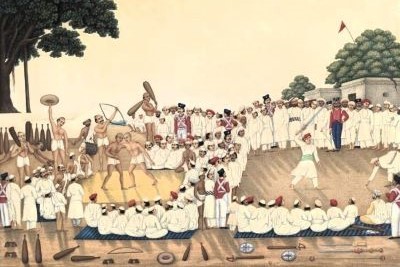
 The term ‘Indian martial arts’ (also commonly referred to as South Asian martial arts) is inclusive of a wide variety of fighting styles and systems developed on the Indian subcontinent, an area which includes, Bangladesh, Bhutan, India, Nepal, Pakistan, Sri Lanka and the Maldives.
 Some experts believe that Alexander the Great's conquest of India in the fourth century BCE may have laid the foundation for the history of Indian unarmed combat styles, with the introduction of pankration techniques, which included ancient boxing, wrestling, kicks, joint locks, and chokeholds. While this remains debated, it is undoubtedly true that warfare has been integral to South Asian culture for millennia and Indian deities are often depicted armed and credited as expert warriors, while sometimes also being revered as founders of particular fighting styles.
Dhanurveda
Dhanurveda (bow knowledge) is probably the earliest type of systemised South Asian martial art and is mentioned in the Vedas (c.1700 – 1100 BCE). It later appears in the Agni Purana, dated to around the eighth century CE, though it cites sources on dhanurveda that date back centuries earlier.
By the time of the Agni Purana, the term dhanurveda is used as a more general term to describe a complete fighting system that details the use of several Indian martial arts weapons including the bow and arrow, sword, spear, iron dart, axe and the trident. It also explains how a warrior can become proficient in unarmed combat and includes instruction in wrestling techniques, punching, kicking, and knee strikes.
Malla-Yuddha
The oldest recorded organised unarmed combat style on the Indian subcontinent is malla-yuddha (wrestling combat). Divided into four forms of wrestling that originated in the Tamil region of South India, it is first attested in the Mahabharata and is believed to date back to at least the fifth century BCE. However, many experts believe that the earliest form of malla-yuddha dates to around 3,000 BCE, suggesting it may predate the Vedic Period and even predate dhanurveda. Krishna is sometimes described as engaging in such wrestling matches (depicted above) which includes knee strikes to the chest, head punches, hair pulling, choking and even biting.
Kalaripayattu
Kalaripayattu (the art of the battlefield), often shortened to Kalari (battlefield), originated in modern-day Kerala and has a long history, dating back to at least the third century BCE. It is a fighting style designed specifically for warfare, and according to Indian mythology, Bhargava Parashurama, the sixth Vishnu, is said to have learned it from Shiva and then taught it to the first twenty-one Kalaripayattu gurus. The style includes kicks, hand strikes, grappling techniques, and training with various weapons, and employs prearranged forms, much like karate kata, as a training method. Unusually, weapons training comes first, with unarmed combat techniques being taught later, and unlike other Indian martial arts, kalaripayattu has a long history of being inclusive to people of all castes and was (and still is) taught to both men and women.
Silambam
Sangam writing from the second century BCE describes the fighting styles of the ancient Tamilakam. Known as silambam, it was predominantly a weapons-based martial art, with a staff made of silambambu wood (from which the style probably takes its name) being of particular importance. However, it also included training in more than thirty other Indian martial arts weapons, particularly swords and bows, as well as unarmed combat techniques. Armour and shields were reportedly sold to foreign visitors, with the silambam staff being a particularly prized item among traders.Indian Martial Arts in the First Millennium CE
In the first century CE, Buddhist texts suggest that Prince Siddhartha Gautama was a champion swordsman and wrestler before finding enlightenment and becoming known as the Buddha. Another early Buddhist text, known as the Hongyo-kyo, talks of a contest of strength between Siddhartha’s half-brother, Prince Nanda, and his cousin, Devadatta. Despite this, during the Buddhist period, martial disciplines were frowned upon to some extent and the Khandhaka specifically prohibits archery, swordsmanship, boxing and wrestling. By the fourth century CE, the history of Indian martial arts had developed and begun to incorporate other elements of the culture, including yogic exercises and traditional dance movements. To this day, some traditional dance schools in India still include martial arts as a part of their exercise regimes. Tantra exercises were also incorporated including Kundalini (coiled energy), Prana (life force), Nadi (meridians) and Chakra (aura).
The Sushruta Samhita, dating to around the fourth century CE, laid the foundation for the traditional Indian medical practice of Ayurveda, which would later be taught alongside early Indian martial arts such as kalaripayattu and adimurai. The text identifies one hundred and seven vital points of the body, of which sixty-four were said to be lethal when struck effectively, either with a weapon or with an unarmed combat technique. Seventh-century granite sculptures commissioned by King Narasimhavarman of the Pallava dynasty depicting fighters using their bare hands to disarm opponents with weapons may show an early form of adimurai. This Dravidian martial art employed a range of techniques that targeted the body’s vital points with the hands, feet, knees, and elbows, but prohibited attacks below the belt.
The Vijayanagara Empire
In the fourteenth century, the kingdoms of South India united to form the Vijayanagara Empire, in which wrestling was very popular among both men and women. Akharas (monastic academies) were said to include the daily practice of various martial disciplines, including boxing, wrestling, and fencing; one account from this period describes this practice as resulting in “men as old as seventy years [who] look only thirty.” Physical exercise was popular in the Vijayanagara Empire among commoners and the upper classes alike, and even royalty were well-trained in the art of combat.
A Persian envoy called Adbur Razzak told of a failed attack on Emperor Deva Raya II (r. 1422 – 1446 CE) and stated: “As he was a man who knew how to use both sword and dagger better than anyone in his kingdom, he avoided by twists and turns of his body the thrusts aimed at him, freed himself from him, and slew him with a short sword that he had.” Pietro Della Valle, an Italian traveller who visited the area, stated that soldiers would often specialise in a particular weapon and practice only in that discipline, thereby becoming highly proficient in its use.
The Mughal Empire
In the sixteenth century, Babur established Mughal rule in Northern India, which lasted from 1526 to 1857. Rajput fighters trained in akharas were employed in the Mughal army, and Mughal soldiers subsequently adopted traditional Indian martial arts. Pehlwani (heroic wrestling) is a form of mud wrestling derived from malla-yuddha that was very popular during the Mughal period. Wrestlers would come from as far away as Iran to compete in Pehlwani, and the style required quick reflexes and great physical strength, as well as practitioners, known as Pehlwani, to have very high levels of fitness and stamina.
Another form of combat popular during Mughal rule was gatka, a Punjabi-Sikh style of sword fighting. The sword was spun at high speed and aimed at vital points on an opponent’s body; in the sixteenth and seventeenth centuries, it was used as protection against the Mughals. In the nineteenth century, a modernised form of gatka was developed that is still popular today. Sticks are often used to practice fighting techniques safely, and millions of people enjoy them as both a sport and a ritual at weddings.
The Maratha Dynasty
The Maratha Dynasty (1674 – 1859) was populated by a warrior class from modern-day Maharashtra who were expert horsemen and fought with swords and spears. The Marathas were united by Shivaji Bhonsale I, who learned the art of mardani khel at a young age and employed guerrilla tactics to reestablish native self-rule and overthrow Muslim dominance. The Marathas later defended their territory against the more powerful and numerous Mughals, again by employing rapid, focused attacks and utilising the rugged, rocky terrain of their territory to effect tactical retreats. The Maratha Light Infantry remains part of the Indian Army and traces its origins to 1768.
Indian Martial Arts and British Colonial Rule
Many forms of Indian martial arts declined with the introduction of firearms and the establishment of British colonial rule in the nineteenth century. Training in combat skills was outlawed mainly from around 1804, following a series of revolts, although some traditional South Asian martial arts survived. In some cases, competitions were held for the entertainment of British spectators who tended to be impressed by the level of violence and the acrobatic nature of some of the fighting styles on display. Despite the ban on martial arts, boli khela (game of the powerful person) is a form of wrestling that originated in Bangladesh as a means for its people to defend themselves against the British. It is a form of hand-to-hand combat that relies heavily on grappling and is practised in a sandy arena similar to those used by Japanese sumo wrestlers.
Written by Andrew Griffiths – Last updated 10/02/2026.
If you like what you see, get your copy of my new book NOW!!
Further Reading:
Chowdhury, S. [Internet]. 2026. A History of South Asian Martial Arts. Desi Blitz. Availavble From: www.desiblitz.com/content/history-south-asian-martial-arts [Accessed 10 February 2026].Dr. Biswas, C. Et Al. [Internet]. 2019. Development of Heath Related Fitness and Psycho-Social Wellness of Girls Through Judo and Karate. Lulu.com. Available From: https://books.google.co.uk [Accessed 10 February 2026].
Indian Martial Arts. [Internet]. 2016. New World Encyclopedia. Available From: www.newworldencyclopedia.org/entry/Indian_Martial_Arts [Accessed 10 February 2026].
Rg, K. [Internet]. 2020. 13 Ancient Indian Martial Arts. Midium.com. Available From: https://medium.com/@krishnarg/13-ancient-indian-martial-arts-71628229f215 [Accessed 10 February 2026].
The images on this site are believed to be in the public domain, however, if any mistakes have been made and your copyright or intellectual rights have been breeched, please contact andrew@articlesonhistory.com.
