

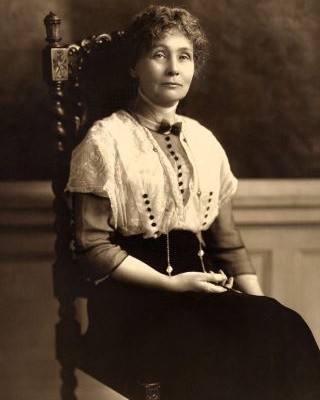
Emmeline Pankhurst (1858 – 1928) was the leader of the militant side of the British suffrage movement. She led thousands of women in the fight for women's suffrage and has since inspired countless others to fight for equal rights and opportunities for women, be it within the law, in the workplace, in the home, or in the political arena.
The Early Life of Emmeline Pankhurst
She was born Emmeline Goulden in Manchester to politically active, middle-class parents, Robert and Sophia Crane Goulden. They were a part of the anti-slavery and female suffrage movements, and her grandfather was a part of the crowd at the Peterloo Massacre and campaigned against the corn laws.
Her birth certificate records her date of birth as 15 July, but it was not filled in until four months after she was born, and later, she would maintain that she was actually born on 14 July.
She was the eldest of ten children and as a young girl, was often tasked with taking care of her siblings. Emmeline was also responsible for reading the newspaper to her father each morning, which helped instil in her a keen interest in politics, and when she was 14, this was further developed as her mother started taking her to suffrage meetings.
She would later criticise one aspect of her upbringing: the education of the boys in the family was prioritised over her and her sisters' schooling, and both her parents considered men superior to women. In her autobiography, Emmeline Pankhurst, My Own Story (1914), she stated that one night, while lying awake in bed, she pretended to be asleep when her parents came to check on her. As her parents looked in on her, her father said, ‘What a pity she wasn't born a lad.’ She stated: "It was made quite clear that men considered themselves superior to women, and that women accepted this situation. I found this view difficult to reconcile with the fact that both my father and my mother were advocates of women's suffrage."
Emmeline, along with her sister Mary (who years later would die after bouts of force feeding, becoming ‘the first martyr to the cause,’) attended their first suffrage meeting in 1872, hosted by one of the original campaigners for votes for women in the UK, Lydia Becker. A year later, she went to Paris to be educated at a progressive school that taught girls traditional feminine subjects, such as embroidery, as well as subjects usually reserved for male students, such as science and bookkeeping.
Marriage and Early Activism
She married Richard Pankhurst in 1879, when she was just 21, despite him being nearly 24 years her senior. He was a progressive Liberal and a lawyer, who wrote an amendment to the Municipal Franchise Act (1869) that resulted in unmarried female householders being able to vote in local elections. He also drafted the Married Women’s Property Act in the same year, which allowed married women to legally own their own property rather than have everything they earned and owned come under their husbands' control.
The Pankhursts had five children together: Christabel, born in 1880; Sylvia, born in 1882; Henry, born in 1884 but died four years later; Adela, born in 1885; and Henry, born in 1889 and named after his deceased brother.
The family moved to London in 1886, where they held meetings with other suffragists and joined the Fabian Society, a precursor to the Labour Party.
Emmeline became involved in the London matchgirl strike in 1888. Female match makers were expected to work fourteen hours a day for what amounted to slave level wages and dangerous conditions that regularly made them sick from various ailments, including cancer. When a group of them were fired for not signing a statement saying they were happy with the conditions of work, 1,400 women of the Bryant & May matchmakers went on strike. The company backed down after three weeks, reinstating the workers who were now unionised and working with improvements to their pay. Pankhurst helped the strike by making unorganised workers national news, bringing awareness to the situation and leading to the formation of many unions across the UK.
In 1889, she helped to form the Women’s Franchise League along with her husband and several other suffragists. At the time, some single women were allowed to vote in municipal elections, and the group managed to extend this to married women as well. The Pankhurst family returned to Manchester in 1893 and helped to form a branch of the Independent Labour Party (ILP) there, a political party that was more sympathetic to the concept of votes for women than most other political organisations.
Emmeline also became a member of the Poor Law Board of Guardians in 1894, where she helped improve conditions at the workhouse in Chorlton, Manchester. She was particularly assertive in bettering the lives of the very old and the young, stating in her autobiography: "The first time I went into the place I was horrified to see little girls … clad, summer and winter, in thin cotton frocks, low in the neck and short sleeved. At night they wore nothing at all, night dresses being considered too good for paupers."
The fact that bronchitis was epidemic among them most of the time had not suggested to the guardians any change in the fashion of their clothes.
She also spoke up for pregnant women in the workhouse. They would have to work hard labour throughout their pregnancy or face leaving and having no means of earning money and nowhere to go. She worked for reform in areas such as girls' education and mental health care, but her success in these areas was limited.
After Richard died in 1898, she needed to find work, so she became a registrar, where she met many women in desperate situations, which made her more determined in her fight for women's enfranchisement.
Emmeline Pankhurst and the Women's Social and Political Union
Due to a disagreements on policy, she left the Labour Party in 1903 after helping with its conception three years earlier. At the same time, she had become disillusioned with the National Union of Women's Suffrage Societies (NUWSS), the main coalition of suffrage societies that had been founded in 1897. She believed that the NUWSS was not making progress fast enough and a more militant approach was required. So, in October of that year, with the help of her daughters Christabel, Sylvia and Adela, she decided to establish the Women's Social and Political Union (WSPU).
The organisation was open only to female members, had no affiliation with any political party, and had the motto "Deeds, Not Words."
Over the years, she led the WSPU from collecting petitions, to disrupting political events and organising demonstrations and marches that involved thousands of people. Pankhurst’s tactical mind and ability to deliver compelling speeches converted many to the cause, but although she and her daughter were charismatic leaders, many in the organisation came to believe they led with an iron fist. They argued that the WSPU should be more democratically run, so in 1907, many members left and formed the Women’s Freedom League (WFL). One of the leaders of the WFL,
Teresa Billington-Greig, stated of her former friend:
To work alongside her day to day was to risk losing yourself. She was ruthless in using the followers she gathered around her, as she was ruthless to herself. She took advantage of both their strengths and their weaknesses, suffered with you and for you while she believed she was shaping you and used every device of suppression when the revolt against the shaping came. She was a most astute statesman, a skilled politician, a self-dedicated reshaper of the world - and a dictator without mercy.
Although Emmeline Pankhurst was a demanding leader, she never asked her supporters do anything she would not do herself. She was arrested multiple times and served numerous prison sentences between 1908 and 1914. Her first arrest was in February 1908 when she was sentenced to six weeks in prison. She had heard many stories from other members of what prisons were like, but the conditions and poor treatment suffered by herself and her fellow prisoners shocked her. She was kept in solitary confinement for much of the time and only allowed an hour of exercise each day. The food was awful, she had to wear prison clothes, including a dress with arrows on it, and was limited to the number of letters she could send and the visitors she could have.
Later in the campaign for the right for women to vote in general elections, WSPU members smashed windows, set fires and planted homemade bombs, though these attacks were intended to damage property and the suffragettes were always careful that nobody got hurt. These actions led to Pankhurst and other leading members of the organisation being arrested on conspiracy charges in 1912, but when this happened, another member was always ready to step in and take over the running of the Women's Social and Political Union. Speaking at Hampstead Town Hall on 14 February 1913, Pankhurst, as recorded in a police report, stated:
For nearly 50 years we had your sympathy and your support, and nothing happened ... Nothing can stop militancy now, and it is going on until we get the vote. We tried by constitutional ways to get you to give us the vote, but you did not do it. What can we do now but carry on this fight ourselves? And I want you, not to see these as isolated acts of hysterical women, but to see that it is being carried out on a plan and that it is being carried out with a definite intention and a purpose. It can only be stopped in one way: that is by giving us the vote.
Author, artist and suffragette Olive Hockin planted two bombs in an empty house belonging to the Canceller of the Exchequer David Lloyd George. The first exploded causing £500 worth of damage but the second failed to go off. Soon after, Pankhurst stated in a speech in Cardiff, “For all that has been done in the past, I accept responsibility. I have advised, I have incited, I have conspired … No measure worth having has been won in any other way.” She was charged with incitement to commit arson and, on 3 April 1913, sentenced to three years in prison. The Times reported on 4 April 1913:
A scene of uproar followed the passing of the sentence. A number of women repeatedly shouted “shame,” and, in the excitement that followed, the voices of male sympathisers joined in the demonstration. There were ironic cheers, and a woman’s voice struck up, “For he’s a jolly good fellow” … the police, amid continued uproar and the singing of the “Marseillaise,” removed those responsible for the disorder.
Another split in the organisation occurred in 1913 when some members opposed the tactics of arson and bombing buildings, most notably leading to a fallout between Pankhurst and her daughters Sylvia and Adela. A year later, Emmeline Pethick-Lawrence questioned the WSPU's tactics and was ousted for her dissent. She had helped lead and fund the WSPU since 1906 and was previously good friends with Emmeline and Christabel Pankhurst. She stated in her autobiography, My Part in a Changing World (1938), “I never saw or heard from Mrs Pankhurst again, and Christabel, who had shared our family life, became a complete stranger. The Pankhursts did nothing by halves!”
The End of the Militant Suffrage Campaign
When Britain declared war on Germany on 4 August 1914, Emmeline Pankhurst called a halt to militant activity. All suffragette prisoners were released, and she toured the country campaigning to persuade women to step up and join the workforce to help the war effort and to convince trade unions and factory owners to allow it.
The war ended in 1918, and that same year, two parliamentary bills were passed: the Representation of the People Act, which allowed some women over thirty to vote, and the Parliament (Qualification of Women) Act, which allowed women to stand as members of parliament.
As a result, the WSPU was dissolved, and Emmeline and Christabel Pankhurst formed the Women's Party. Christabel stood for election in the Smethwick constituency in Staffordshire and, despite receiving 47.8 per cent of the vote, lost to the only other candidate, local trade union leader John Davison of the Labour Party.
The Women’s Party stood for various issues concerning the women’s movement including equal pay for equal work, and equal marriage and divorce laws. However, it was short-lived, dissolving in 1919, after which Emmeline’s political focus changed.
She became concerned with the rise of Communism, and she toured countries such as the USA and Canada lecturing for the National Council for Combating Venereal Disease, and acted as a moral crusader, speaking out against promiscuity.
She then helped run a tea shop on the French Riviera in 1925, before returning to London a year later after it failed to turn a profit. She joined the Conservative Party and ran for a parliamentary seat in East London, but ill health hampered the campaign, and she was unsuccessful.
The Representation of the People (Equal Franchise) Act of 1928 (also known as the Fifth Reform Act), gave women over twenty-one the right to vote regardless of property ownership, meaning they finally had the vote on the same terms as men, which had been the ultimate goal of the women’s suffrage movement of Britain. The bill was introduced in March, but she died of septicaemia on 14 June 1928, aged 69, just eighteen days before the bill came into law. Two years after her death, Emmeline Pankhurst was commemorated with a statue in London’s Victoria Tower Gardens, which was unveiled by the Prime Minister Stanley Baldwin, who had strongly opposed the enfranchisement of women.
Written by Andrew Griffiths – Last updated 26/01/2026.
If you like what you see, get your copy of my new book NOW!!
Further Reading:
Atkinson, D. 2018. Rise Up Women – The Remarkable Lives of the Suffragettes. Bloomsbury. London.
Emmeline Pankhurst. [Internet]. 2021. Biography.com. Available From: www.biography.com/activists/emmeline-pankhurst [Accessed 26 January 2026]
Emmeline Pankhurst – British suffragist. [Internet]. 2025. Britannica. Available From: www.britannica.com/biography/Emmeline-Pankhurst [Accessed 26 January 2026]
Emmeline Pankhurst: Freedom or Death. [Internet]. 2026. v. Available From: https://www.rev.com/transcripts/emmeline-pankhurst-freedom-or-death [Accessed 26 January 2026]
Emmeline Pankhurst – Suffragette Icon. [Internet]. 2025. London Museum. Available From: www.londonmuseum.org.uk/collections/london-stories/emmeline-pankhurst-suffragette-icon [Accessed 26 January 2026]
Pankhurst, E. [Internet]. 1914. My Own Story. London Eveleigh Nash. London. Available From: www.gutenberg.org/files/34856/34856-h/34856-h.htm [Accessed 26 January 2026].
Simkin, J. [Internet]. 2023. Emmeline Pankhurst. Spartacus Education. Available From: https://spartacus-educational.com/WpankhurstE.htm [Accessed 26 January 2026]
The Story of Emmeline Pankhurst. [Internet]. 2025. The National Archives. Available From: www.nationalarchives.gov.uk/explore-the-collection/stories/emmeline-pankhurst [Accessed 26 January 2026]


The images on this site are believed to be in the public domain, however, if any mistakes have been made and your copyright or intellectual rights have been breeched, please contact andrew@articlesonhistory.com.
