


 Throughout the history of wrestling, there have been three basic types of contests: belt-and-jacket, catch-hold, and loose wrestling. Belt-and-jacket is a wrestling style in which the fighter's clothing is designed to be the primary point of contact between the wrestler and his opponent. This could be in the form of specially designed jackets and trousers, and/or the use of a belt that is easy to hold on to.
 Catch-hold styles begin with a specific hold being executed at the start of the bout with many requiring the wrestlers to maintain this grip throughout the contest. Loose styles of wrestling start with opponents separated from each other, who are then free to take any grip they see fit within the confines of the rules of the particular type of wrestling being practised.
The sport of wrestling can also be broken down into how a win is achieved, with the main categories being break-stance, toppling, touch-fall, pin-fall and submission wrestling (though some styles employ a combination of these methods of victory). Break-stance is when a wrestler is required to force his opponent to give up a posture or position, while a toppling style is when an opponent must be made to touch the ground with some part of their body (other than their feet).
Touch-fall wrestling requires that an opponent is forced into a given position (usually on his back) for a brief moment while pin-fall requires an opponent to be forced into a given position (again usually on his back) and held there for a set length of time. Submission wrestling requires that one of the wrestlers submits and concedes the bout, either verbally or through a predetermined hand signal such as tapping three or more times on the ground, his opponent or on himself.
Ancient Wrestling History
Wrestling is believed by many to be the oldest form of combat sport, and we can trace its origins back to at least 15,000 to 20,000 years ago, as demonstrated by cave paintings found in France. More cave paintings found in the Bayankhongor Province of Mongolia, dating back to around 7,000 BCE, depict two naked men wrestling while a crowd looks on, suggesting that by this time it may already have been practised as a spectator sport.
Wrestling is known to have been practised in the earliest civilisation, Sumer (modern-day southern Iraq), as early as 3,000 BCE. This is evidenced by carvings on a stone slab depicting three pairs of ancient wrestlers, the Epic of Gilgamesh, which describes refereed wrestling contests accompanied by music and a cast bronze figurine, believed by some to be the base of a vase, that portrays two men engaged in a wrestling contest.
In ancient Egypt, wrestling was a common sport, and wall paintings in the tombs of the Pharaohs dating back to around 2,500 BCE have been found depicting belt wrestling moves similar to those still practised today in several countries, including Japan and Switzerland. The most famous of these paintings was discovered in the tombs of Beni-Hassan, where around 400 wrestling matches are depicted. In China, legend states that the Yellow Emperor had his troops trained in wrestling when they fought against the rebel Chih Yiu and his army in 2697 BCE. Grappling moves were used in these fights, though the style got its name, Jiao Ti (butting with horns), from the horned helmets worn by the fighters, which they used to gouge opponents.
Wrestling history in India dates back at least 2,500 years, with the oldest form practised on the subcontinent being malla-yuddha. Grappling, joint locks, choking, punching, pressure point strikes and even biting were allowed under the rules. According to legend, Krishna was a master of the ancient wrestling style, and even Prince Siddhartha Gautama practised Malla-yuddha before he reached an enlightened state and became the Buddha.
Wrestling was very popular in ancient Greece and was said to be practised by both humans and the gods. According to the poet Pindar, Zeus ultimately took control of the universe by defeating his father, Cronus, in a wrestling match, and his victory was commemorated at the ancient Olympics from the eighth century BCE.
Wrestling was an integral part of ancient Olympic history and was probably its most popular event. The athletes fought completely naked, coated their bodies in olive oil, and then covered themselves with a thin layer of sand to protect them from the elements. The prevalent style was loose wrestling, in which the two opponents began separately and engaged in a toppling bout. A competitor would need to throw or take his opponent to the ground, either on his back, knees, flat on his front or propped on his elbows and once this was achieved, the wrestler would be declared the winner.
The popularity of the sport continued into the Roman Period and attracted people from all walks of life. It was also part of the military training of Roman soldiers, so much so that, according to the second-century Roman historian Cassius Dio, the wrestling schools of ancient Rome, known as palestra, were the origin of their military success. As their territories spread, so did the popularity of their kind of wrestling and by the second century CE, the no-holds-barred style known as catch-as-catch-can, which was the forerunner to modern freestyle wrestling, had emerged.
Medieval Wrestling History
At the end of the Roman Period, little is written about wrestling in Europe until it reemerged around 800 CE, probably because the Catholic Church imposed strict rules prohibiting combat sports because of their violent nature. In Britain, several medieval wrestling styles emerged that are named after the areas in which they were conceived, including Cumberland, Westmoreland, Cornwall, and Lancashire. The rules for each of these styles vary; for example, in Cornish wrestling, fighting on the ground is prohibited, and in the Cumberland system, the contest is lost if any part of the body besides the feet touches the ground.
In late medieval Europe, wrestling was practised by all classes, even royalty. At a summit meeting between Henry VIII of England and Francis I of France, which became known as the Field of the Cloth of Gold, the two kings were so excited by the wrestling matches they were watching that Henry challenged his counterpart to a match and was duly thrown by the French monarch. Several different styles emerged over the period, and medieval knights were often trained in the art of wrestling, with manuscripts produced to teach them. For example, in 1512, a manual entitled ‘Fechtbuch’ or ‘Fight Book’ drawn by the German artist Albrecht Dürer (1471–1528), was printed and published depicting wrestling moves (see above) along with dagger and sword techniques.
Elsewhere, wrestling was also regaining popularity. In Turkey, a style of loose wrestling called koresh was practised as far back as 800 CE, and a match ended when a combatant was briefly forced onto his back. This style spread through the Islamic world through the use of Turkish mercenaries and later was prevalent in the Ottoman Empire. Also, from around the eighth century, sumo wrestling became popular in Japan and evolved into a toppling style in which the losing fighter is forced to touch the floor with anything other than his feet. Victory can also be achieved in sumo by forcing your opponent out of the four-meter circle.
Professional Wrestling History
From around 1830, wrestling troupes were established in France that travelled around the country, demonstrating their talents in carnival and circus-style settings. The wrestlers would be introduced with colourful names such as Edward 'the Steel Eater', Gustave d’Avignon 'the Bone Wrecker' or Bonnet 'the Ox of the Low Alps'. Much like the combatants in boxing booths, they would fight each other for the entertainment of the onlooking crowd, with exaggerated, extravagant moves, and they would also challenge audience members to fight them, offering a reward to anyone who could take them to the ground.
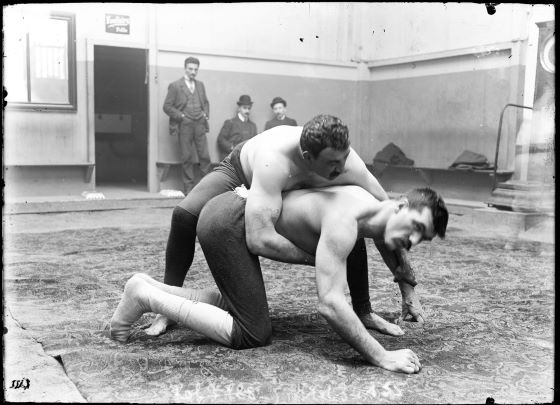
This predecessor to modern professional wrestling spread with varying rules and in 1898, the Frenchman Paul ‘the Colossus’ Pons (pictured below on the right) made history and became professional wrestling’s first World Champion. Other notable historical pro wrestlers included the Russian George Hackenschmidt, who was World Freestyle Champion from 1905 – 1908, and the American wrestler Frank Gotch, who took the crown from Hackenschmidt and retained it until his retirement in 1913.
Despite its obvious entertainment value, professional wrestling lost much of its popularity in the early twentieth century as boxing grew and amateur wrestling, especially with the onset of the modern Olympic Games, gained popularity. To combat this, pro wrestling began to resemble its modern form becoming more of an entertaining spectacle than a serious sporting event. Fighters were presented as ‘heroes’ or ‘villains’, and the outcome of bouts were often predetermined. However, the ever-increasing extravagance of the moves and larger-than-life characters did appeal to many people, and its audience gradually grew, especially in the United States of America and in Mexico, home of the lucha libre (literally meaning free fight) professional wrestling style, famous for its masked fighters and extensive use of aerial acrobatics.
Greco-Roman and Freestyle Wrestling
From the second half of the nineteenth century, two wrestling styles emerged in the Western world that would go on to dominate the sport. They were Greco-Roman wrestling and freestyle wrestling (also known as catch-as-can), both of which started as professional but were soon accepted by amateur governing bodies. Greco-Roman wrestling derives its name from its supposed similarity to the ancient wrestling practised in Greece and Rome. It first became popular in France and is restricted to holds above the waist, prohibiting the use of legs when the fighters go to the ground.
Both Freestyle and Greco-Roman are touch-fall types of wrestling, with the aim being to get the opponent on his back so that both shoulder blades are touching the ground at the same time. This is only required to happen for an instant and can be achieved with a throw or by pressing the opponent to the ground.
Freestyle wrestling was popularised in the UK and the USA, and unlike Greco-Roman wrestling, it allows fighters to utilise their legs, either defensively or offensively. While this is the only rule difference, it makes the two styles differ greatly.
Modern Olympic Wrestling History
When the Olympics were restored in 1896 in Athens, Olympic wrestling history was restored alongside it, and it was one of the ten sports included. Only five men competed, with no weight categories, in the Greco-Roman style. The wrestlers themselves were not all trained in the sport and the final was won by German athlete Carl Schuhmann, who also won three titles in the gymnastics and competed in the weightlifting contest. In the first round, Schuhmann faced Launceston Elliot of Great Britain and Ireland, the weightlifting champion and a much larger man, but quickly dispatched him with a body lock. After getting a bye in the semis, he faced Georgios Tsitas of Greece in the final, who was also larger than the German. After forty minutes of fighting, the match was postponed until the next day and when the bout was resumed the next morning, Schuhmann quickly emerged the winner.
Four years later in Paris, wrestling was omitted altogether for the only time in the history of the modern Olympic Games. When the sport returned in the 1904 Games in the USA, weight classes were added along with a Freestyle wrestling category, which has been present in all subsequent Olympics except the 1912 Games in Stockholm, Sweden. With the arrival of Freestyle wrestling in 1904, Greco-Roman wrestling was absent; however, it has been an ever-present part of the program ever since. It was not until the 2004 Games in Athens that female wrestlers were allowed to compete.
Today, the International Amateur Wrestling Federation recognises over 160 variants of the sport, and it is as popular as ever. With the rise of MMA, wrestling has gained even more exposure as many successful fighters of the UFC and other MMA organisations, have and continue to come from a wrestling background. On top of this, both amateur and professional wrestling are thriving, and wrestling continues to be one of the most practised combat sports in the world.
Written by Andrew Griffiths – Last updated 04/03/2026.

Augustyn, A. [Internet]. 2026. Wrestling. Britannica. Available From: www.britannica.com/sports/wrestling [Accessed 26 February 2026].
Dellinger, B. [Internet]. 2026. The Oldest Sport. National Wrestling Hall of Fame. Available From: https://nwhof.org/national-wrestling-hall-of-fame/pages/the-oldest-sport [Accessed 26 February 2026].
The History and Origins of Wrestling. [Internet]. 2026. Evolve Daily. Available From: https://evolve-mma.com/blog/the-history-and-origins-of-wrestling [Accessed 26 February 2026].
Wrestling. [Internet]. 2026. New World Encyclopedia. Available From: www.newworldencyclopedia.org/entry/wrestling [Accessed 26 February 2026]
If you like what you see, get your copy of my new book NOW!!
Further Reading:
A Brief History of Wrestling. [Internet]. 2026. United World Wrestling. Available From: https://uww.org/organisation/history-wrestling-uww [Accessed 26 February 2026].Augustyn, A. [Internet]. 2026. Wrestling. Britannica. Available From: www.britannica.com/sports/wrestling [Accessed 26 February 2026].
Dellinger, B. [Internet]. 2026. The Oldest Sport. National Wrestling Hall of Fame. Available From: https://nwhof.org/national-wrestling-hall-of-fame/pages/the-oldest-sport [Accessed 26 February 2026].
The History and Origins of Wrestling. [Internet]. 2026. Evolve Daily. Available From: https://evolve-mma.com/blog/the-history-and-origins-of-wrestling [Accessed 26 February 2026].
Wrestling. [Internet]. 2026. New World Encyclopedia. Available From: www.newworldencyclopedia.org/entry/wrestling [Accessed 26 February 2026]
The images on this site are believed to be in the public domain, however, if any mistakes have been made and your copyright or intellectual rights have been breeched, please contact andrew@articlesonhistory.com.
